The rapid evolution of the consumer artificial intelligence ecosystem has marked a pivotal transition from simple text-based interactions to advanced, real-time voice systems. At the forefront of this revolution is Stimuler, an innovative English coaching app designed to aid the global English-as-a-Second-Language (ESL) community. This piece examines Stimuler’s ascent, underscoring its impact and the achievements of its founders, recently highlighted in Forbes’ 30 Under 30 Asia Class of 2026.
The Forbes 30 Under 30 Milestone
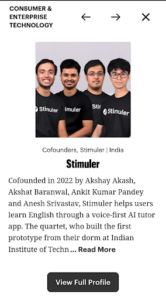
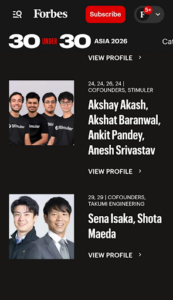
Stimuler’s journey to being a household name in the ESL community has been meteoric. Founded by Akshay Akash, Akshat Baranwal, Ankit Kumar Pandey, and Anesh Srivastav, this voice-first application stands as a testament to the founders’ strategic acumen and technical prowess, recognized by their inclusion in the prestigious Forbes 30 Under 30 Asia Class of 2026 under the Consumer & Enterprise Technology category.
In 2023, Stimuler’s technical excellence was further validated when it won the ‘Best AI App of the Year’ award on Google Play, reflecting a strong product-market fit early in its lifecycle. The startup was further distinguished by being one of the select few, and one of only three from India, chosen for the AWS Generative AI Accelerator (GAIA) Class of 2025—a recognition that offered substantial cloud infrastructure support and mentorship. These institutional recognitions highlight the global technical validation that Stimuler has achieved in just a few short years.
Collegiate Foundations: The IIT (BHU) Varanasi Ecosystem
The foundation for Stimuler was laid at the Indian Institute of Technology (BHU) Varanasi. The founders capitalized on their diverse academic backgrounds, combining their experiences to tackle real-world challenges. Akshay Akash, noted for his technical leadership, thrived within the supportive ecosystem of IIT (BHU), a milieu that encourages academic and entrepreneurial growth.
Notably, Akshay and co-founder Anesh Srivastav crafted insightful newsletters during their academic tenure, which uncovered the socio-economic barriers impeding many students in developing economies despite their literacy in English. Their realization of the gap between written literacy and verbal proficiency inspired partners like Akshay and Ankit Kumar Pandey to innovate a solution leveraging cutting-edge AI.
Collaborative Efforts and Technical Contributions
Akshat Baranwal’s mobile development expertise played a crucial role in developing the platform’s user interface. His previous projects, such as a feedback management system at the university, established his coding proficiency. The integration of Akshay’s leadership with Ankit’s AI specialization and Anesh’s consumer focus created a robust foundation for Stimuler’s interface.
To see how institutions like IIT (BHU) support such student-led innovations, you can explore their campus infrastructure support which plays a pivotal role in nurturing technological advancements.
Pedagogical Philosophy and Custom Audio-AI Architecture
Stimuler has redefined language learning philosophies by prioritizing active engagement and verbal fluency over passive learning. The application employs AI-driven methodologies across three major modules:
- 60-Second Speech Loop: Facilitates user engagement through short, focused speaking exercises followed by rapid feedback on their delivery.
- Dynamic Scenario Roleplays: Immerses users in contextual conversations, requiring real-time adaptive responses.
- Live AI Voice Calls: Offers a simulated yet interactive experience to mitigate speaking anxiety and enhance user confidence.
This architecture, built with in-house models, ensures that feedback is precise, coherent, and contextual, addressing pronunciation, grammar, and vocabulary diversity—a pioneering feat in AI-driven language education. Such innovation is why research sponsorships are vital for continuous AI advancements in education.
Financial Trajectory and Corporate Capitalization
Stimuler’s financial strategy emphasizes capital efficiency. The startup transitioned from receiving modest educational grants to securing significant capital from international venture capitalists, demonstrating a scalable economic model.
As of 2025, the company’s valuation and investor interest underscore its trajectory and potential within the global language learning market. The venture witnessed significant investment rounds, backed by leading firms such as Lightspeed Venture Partners, ensuring strategic alignment and sustained growth.
For students at IIT (BHU) who face financial constraints, initiatives such as their scholarships and financial aid programs offer vital support, enabling groundbreaking projects like Stimuler to come to life.
Conclusions and Strategic Implications
The success story of Stimuler illuminates key trends within consumer technology:
- High Operational Leverage: Demonstrates the power of Generative AI to optimize operational efficiency.
- The ‘India-for-the-World’ Strategy: Establishes a global-first approach leveraging competitive Indian talent to serve underserved markets.
- Fluency-Centric Learning: Reinforces the shift towards technologies that prioritize speaking engagement, aligning with global educational needs.
Despite the challenges of scaling in a competitive marketplace and maintaining infrastructure efficiency, Stimuler’s robust AI models, fiscal discipline, and expanding global reach position it well for continued growth.
For more insights on technological advancements and entrepreneurial journeys, check out the blogs of IIT (BHU) alumni that document the successes and strategies of leaders in tech innovation.
Ultimately, Stimuler exemplifies how innovative use of AI can bridge educational gaps, showcasing the impact of strategic academic and business alignments in today’s digital age.