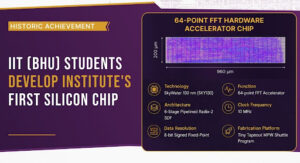
In an extraordinary development, IIT (BHU) Varanasi marks a significant milestone by producing its first silicon chip, showcasing the innovation and prowess of its undergraduate students. This event not only symbolizes the capabilities of students but also enhances India’s ambition of achieving technological self-reliance, particularly in the semiconductor sector.
 =
=
The Genesis of a Pioneering Project
The journey began with a dedicated team of second-year B.Tech students from the Department of Electronics Engineering. Their objective was to construct a 64-point FFT (Fast Fourier Transform) Hardware Accelerator chip using the SKY130 process design kit. Within a commendably short span of five months, these young visionaries submitted their design for fabrication through the Tiny Tapeout Multi-Project Wafer (MPW) Shuttle Program.
The Team Behind the Innovation
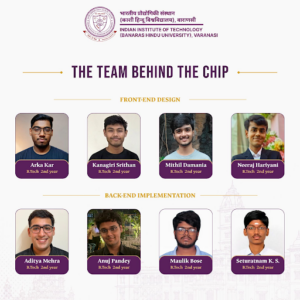
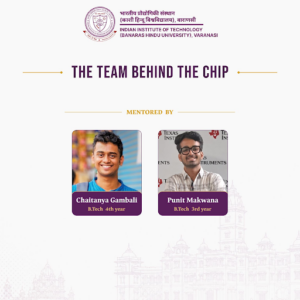
The pioneering team consisted of Arka Kar, Mithil Damania, Neeraj Hariyani, Kanagiri Srithan, Aditya Mehra, Anuj Pandey, Moulik Bose, and Seturatnam K. S., mentored by senior students Punit Makwana and Chaitanya Gambali. Expert guidance from Dr. Ankit Arora and Dr. Muralikrishnan Srinivasan, along with alumni support, was instrumental in executing the project.
Support and Guidance from IIT (BHU)
Mentorship played a crucial role in this achievement. Faculty members like Dr. Ankit Arora and Prof. Amritanshu Pandey greatly inspired these students by actively promoting research in semiconductor and VLSI technologies. This backing is a testament to the institute’s commitment to advancing research and faculty support initiatives.
Alumni Contributions
The AURA (Advanced Undergraduate Research Avenue) Lab played a critical role in nurturing this project. Alumni support, extending from classes graduating between 1975 to 2025, was pivotal. Notable contributions from Vijay Panyala and Mr. Shashank Bhonge in providing valuable technical input cannot be overstated. Their efforts in bringing together scholarships and financial aid initiatives were indispensable in fostering an environment conducive to cutting-edge research.
AURA Lab: A Catalyst for Innovation
The AURA Lab is emerging as a vital component of IIT (BHU)’s infrastructure, spurring student-led innovation and facilitating engagement with deep-tech engineering challenges. Spearheaded by alumni like Sri Sunil Khanna and Sri Sagar Bhimavarapu, the Lab creates a unique ecosystem for students to translate theoretical concepts into practical applications.
Impact on India’s Semiconductor Ecosystem
This project holds promising potential for bolstering India’s semiconductor ecosystem. By empowering students through state-of-the-art infrastructure and research opportunities, IIT (BHU) sets an example for fostering technological advancements at the academic level.
Conclusions and Future Prospects
The creation of the first silicon chip at IIT (BHU) represents not just an academic achievement but a beacon for future explorations in electronics and semiconductor systems. Congratulations are due to the entire student team, mentors, and alumni whose concerted efforts have culminated in this notable success.
Looking ahead, the institutional focus will remain on experiential learning and developing robust research capabilities. With ongoing projects and a commitment to excellence, IIT (BHU) is poised to make further contributions to the global semiconductor landscape.